There’s nothing quite like Paris in the rain. The forecast called for showers upon our arrival, and the thunder and lightning show we received after arriving at the hotel certainly delivered. But as the weather goes in Europe, if you wait five minutes, it will probably change. And it did just in time for aperativo hour on the 34th floor of our hotel.
I was a bit nervous about the dinner I had booked if it was going to be raining. You see, Bustronome brings new meaning to the term “meals on wheels.” The idea here is that you see the sights while eating your meal as the bus winds around the different arrondissements. I feared that the visibility might be compromised for us diners, not the driver. But Mother Nature cooperated and we were treated to a unique and excellent culinary experience under the domed glass roof of a double-decker bus.
Dinner Starts at L’Arc de Triomphe
Bustronome Upper Deck
Our evening started adjacent to L’Arc de Triomphe. As the six courses (and wine pairings, if you opt-in) were delivered, I had a lovely conversation with the owner’s daughter. Once she discovered that I spoke French, she insisted that we only converse that way for me to practice. Bien sur! The six courses included a raw salmon starter with yuzu, chestnut cream soup with roasted morels, a roasted cod with barley risotto and crisp carrots, a filet of beef with parsnip purée and beef jus, a cheese course of Ossau-Iraty, and a decadent Opera Gateau chocolate mousse cake for dessert.
This gourmet travel experience cost €120, and the wine pairings were extra. The food was excellent considering it was being served from the lower level of a double-decker bus navigating Paris’ sometimes unforgiving cobblestone streets. And the menu rotates just like the wheels on the bus, so there are often repeat guests. That should tell you that it’s a lovely way to dine in a city that has the most One Michelin-starred restaurants in the world. 639 to be exact.
Customized Acrylic Glass Holder
Musée du Louvre
We snaked from the right bank to the left bank as the sun set over Paris taking in sights and monuments like Place de la Concorde, Musée du Louvre, Hotel de Ville, the Pantheon, Place Vendome, and more. It ended up being a completely clear evening, which gave awesome views from the bus’s large picture windows and glass domed roof. This made the final stop at the Eiffel Tower picture-perfect, as it was timed at 10:00 p.m. for the light show.
When you only have 24 hours in Paris, you have to make the most of it. Mine came on a work layover, or a paid vacation as I affectionately refer to it as. So, Bustronome was a genius way to kill two birds with one stone. If you’re headed to Paris with a limited amount of time, I definitely suggest this as an option. It’s easy to book on OpenTable.com, and they were extremely responsive over email with a quick question that I had.
The Eiffel Tower at 10:00 p.m.
Bustronome operates three buses in Paris, along with a London bus as well.
As many of you know, I just returned from some time away in the South of France. It should come as no surprise that I love spending my travels learning new things, and this was hardly an exception.
Several months ago, I got the idea of going to France for an immersion-style getaway where I would stay with a family during my time there. The hope was to improve my French speaking skills, and what better way to accomplish that than by living with at least one native speaker? I had been looking around, but wasn’t really finding anything that felt like the right fit.
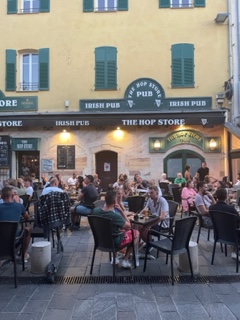
Port Campus: Above the Irish Pub
In doing additional research and talking to coworkers, I stumbled across something even better. A French school called Centre International d’Antibes. They’ve been around since 1985, so they’ve been doing this for quite a while, and it seemed like it was worth looking into. Especially because they are accredited by my airline in the event that I decide to take our language of destination (LOD) test to be a French speaker.
I looked over what they offered, submitted my intent to enroll, took my placement test, and a few months later, I was on the nonstop flight from Atlanta to Nice.
Le Figuier de Saint Espirit
Several people asked me to recount the experience after I returned, and I figured the best way to capture this information was on my blog. I mean, let’s face it: I stuffed my face along the way too at some pretty incredible restaurants. I’ll include the names and links to those at the bottom of the post! For consistency, of course.
But first: a recap of my week as a student in the South of France!
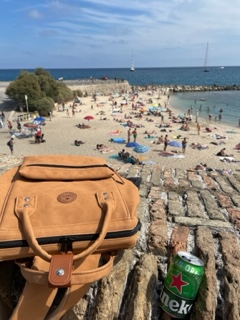
Plage de la Gravette
The first thing that comes to mind is just how happy I am that people arrived from all of the world to study a foreign language that wasn’t English. We’ve come to a time where English has become the default language around the world. You say something in a foreign language to be polite or try your hand, and the person invariably replies in English, because they also want to practice. But sitting in my French classes (where, of course, everyone in the room spoke English in some capacity), it wasn’t allowed. We were there to speak French. Et c’est tout.
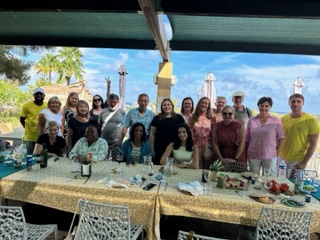
Pan Bagnat Cooking Class
My class was filled with all walks of life from around the world. It was fun to be one of the only Americans, and they were shocked that I came from so far away for just a week’s worth of classes. But such is the life of a flight attendant, which I explained to them on day one when we introduced ourselves. We had someone as young as 15 years old in our class; a young girl from Switzerland spending three months studying. All the way up to a 65-year-old hoping to better his French skills. It was an all ages affair.
Field Trip to Grasse
And because I enrolled in the Cultural Program, where we went on field trips each afternoon post-class, I met even more people. As a quick recount, there were students in the program from Denmark, the UK, Bratislava, Brazil, Norway, Botswana, Canada, the Netherlands, Australia, and several from both Switzerland and Germany. Plus, I’m sure many more.
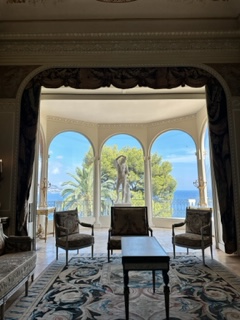
Villa Ephrussi de Rothschild: Saint-Jean-Cap-Ferrat
There are actually two school campuses, and most of us spent our week down in the Port of Antibes location. It was really cool because we were right in the middle of it all, and could go grab a croissant and something to drink on our quick, mid-morning school break. I even had a laid-back lunch or two before rejoining the group for our afternoon excursions. I will say that it was quite a hike from the “Dormtel,” a word that I made up to capture the spirit of where we lived. Was it a dorm? Was it a hotel? Who could know. But this is where we were assigned to live for the week near Juan-Les-Pins, and we braved the heat and humidity each morning on our journey to school. I suppose that’s how French women don’t get fat; they walk. Everywhere. Rain or shine. C’est la vie.
Le 1939 Hotel: Quinto Cielo
Some other observations I had were just how many returning students there were! One guy in my class (a train conductor…how cool is that?) comes every year, and he knew our professor, Patricia, and also knew that it was her birthday the final day of class. So he brought Swiss chocolates as a gift that we all shared in the classroom.
Another new friend, a Lufthansa flight attendant named Suz, said she plans to come back monthly and pop-in for a week here and there. You can only imagine how my geographical jealousy took over when she told me that! There were actually a number of flight attendants (past & present) who I met during the week. Maren was the first person I spoke to while we waited for our rooms to be ready in the “Dormtel” courtyard. We got to talking, and she had been a flight attendant for 27 years with various European airlines. Suz, Maren and I swapped stories all week at dinner, while the others laughed and listened to our wild tales. And Maren got to live vicariously through us since she now has an office job.
Wine Tasting at Château de Crémat
The real takeaway here is just how big the community of international travelers is who take foreign language holidays. It was really incredible! I almost cried on the last day of school because I was genuinely sad to leave. It was by far one of the most rewarding and fun experiences I’ve ever had. I made fast friends with a small but unique group of people who I have no doubt I will see again. I’ve already started brainstorming work trips to see some of them. I’ve said it before and I’ll say it again: there’s nothing like this job if you’re an international citizen with friends in all corners of the globe.
But back to the classes. My class was level A-2, and it was taught rapidly and entirely in French. There were only 12 of us in the tiny (and sweltering) classroom with varying degrees of French speaking ability, so that made the classes both fun and challenging. Occasionally, we would whisper something to each other in English for clarification. And Google Translate helped us search for words we didn’t know or needed to see for ourselves. It was so weird to be a student in the 21st Century with technology at my fingertips!
Would I go back and do this again like some of the friends that I met? Absolutely. In fact, I plan to. Maybe even with some of those friends. But I will definitely go for longer than one week next time and I will stick with an Airbnb in town. The one I rented for my first two nights in Antibes was less than a three-minute walk from school and it was perfect. I would choose that next time without a doubt.
Port Vauban: Antibes
I also want to speak on Antibes, where the classes were held. I didn’t do a ton of research ahead of time, which is unlike me, and I didn’t really arrive there with any expectations. But I kind of liked it. It allowed me to take it all in and form my own opinion with boots on the ground. And that opinion is, Antibes is magic.
It’s not flashy at all. It honestly reminds me a lot of Newport Beach before so many nouveau-riche people moved in and have changed it for the worse. It’s really just a beach town with a giant port (2,000 slips, to be exact) attached. That makes it the biggest anchorage in Europe, so you can bet that there were some pretty incredible yachts bobbing in the harbor. But you would never know it on-land. On the last day of class, our assignment was to take a list of questions and interview people around town. Three of us set out, half expecting to be shut down at every turn. But it wasn’t like that at all. People were friendly, interested and truly excited that we had come from three different countries to learn their language and enjoy their port city.
Domaines Ott: Bandol
Sunrise in Bandol
After Antibes, I took the train to an even smaller town to the west called Bandol. The French rosé we love most in the world hails from there, so it seemed like a logical choice since I was already so close. I stayed for two nights with assistance from an amazing Airbnb host. She helped me correct an idiotic oversight that almost left me homeless there for a night. I guess there are worse places to be without shelter than a beach town on the Cote d’Azur though! In fact, the little town is so small that I think it only has one Uber. She was appalled when we looked up the price to go five minutes back to the train station on Monday morning, and she couldn’t take me because she had to work. So, she phoned her Mom & Dad and they came and picked me up. When I tell you that I continually run into the most hospitable people around the world, I mean it. They spoke very little English, and were thrilled to hear about my courses in Antibes as they whisked me to the platform for my train to Marseille and then onto Paris.
The takeaway here is that you’re never too old to be a student if you really want to be one. And as a lifelong learner who has intense intellectual curiosity, I’m always going to further my pursuit of education, whether that’s with a whisk in my hand or a pocket translator hidden from my professor’s view. Because let’s face it, there were probably just as many lessons learned outside of the classroom along the way as there were inside of it.
One of the awesome things about working for Delta is that we can pick-up trips from other bases. I’ve done this quite a bit internationally, as it’s an awesome way to score a 24-hour paid vacation to somewhere fabulous. While some people think it’s crazy to fly that far for a short period of time, I see it as an opportunity to do something unique and cool.
This time: Stockholm, Sweden!
Weeks ago, I took a gamble and booked a food walking tour in the city. The reason it’s a gamble is because any airline employee will tell you that the kiss of death for a layover is making plans. Delays, cancellations, re-routes often mean we don’t make it to our intended destination. But I had a good feeling and it paid off.
We landed last Sunday morning in Stockholm at 0745 local time, made our way to the hotel, and I took my usual two-hour nap. Having something planned is a good way to ensure you don’t sleep the day away, which is easy to do when you’ve been up all night working.
I got up, got ready, and went and found the metro. I was promptly mistaken for a Swede, with someone asking me for directions on the platform in a language I won’t even pretend to understand. After a relatively short ride in a subway car packed with soccer fans, I emerged at the department store meet-up point for the tour.
You can imagine my surprise when I ran into two customers from our flight. Well, and theirs too to be fair. They saw me and said, “Weren’t you our flight attendant from New York last night?!” I was. We had a laugh, considering we were 30% of the 10-person tour.
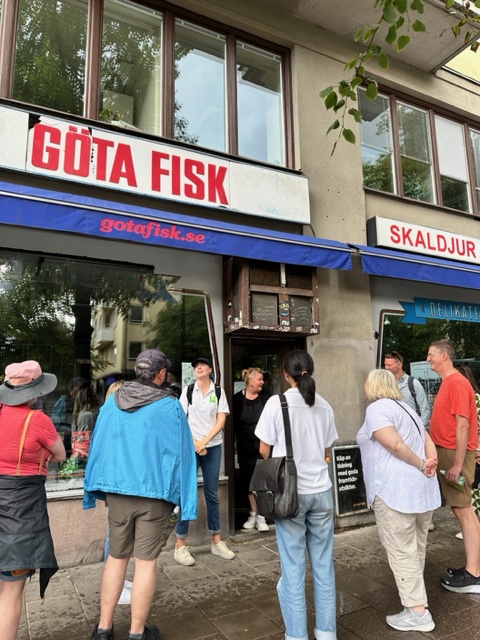
It turns out that booking with Food Tours Stockholm was an excellent choice. Their Culinary Södermalm tour took us around an old working class neighborhood in the city that’s now super trendy and packed with unique restaurants and independent shops. Despite the intermittent torrential downpours, we were able to hit-up seven culturally-diverse places, where we sampled food and beverages at each one.
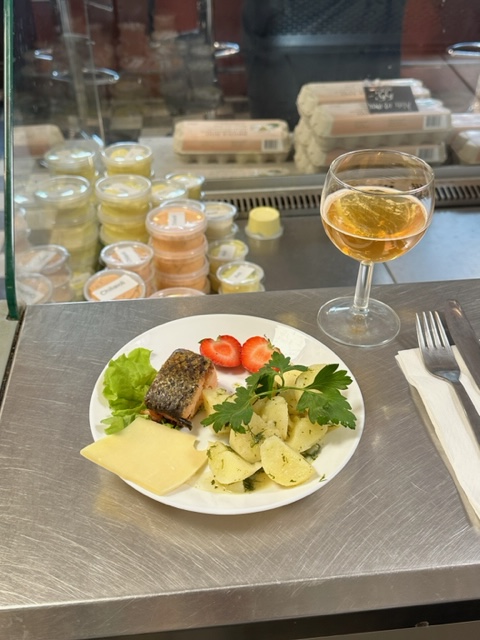
Stockholm can be a pricey city, so at $85 USD, it was an amazing value. We spent 3.5 hours with our guide, Anna, and I was literally stuffed at the end! We snaked through Södermalm and feasted on Chinese, Swedish, Greek, Indian, and Japanese delicacies, with an intermediary stop for gelato/sorbet. And we finished the tour at a chocolate factory.
Oh, and I would be remiss if I didn’t mention how absolutely legendary they were in working with my egg allergy. Each restaurant had clearly been briefed, and alterations were made to my dishes so that I could fully participate. The hospitality was really amazing.
You all know that a culinary lens is the one I want to travel through, and this truly did not disappoint. My crew was so excited to hear about the tour on our flight back, and agreed it was a well-laid plan.
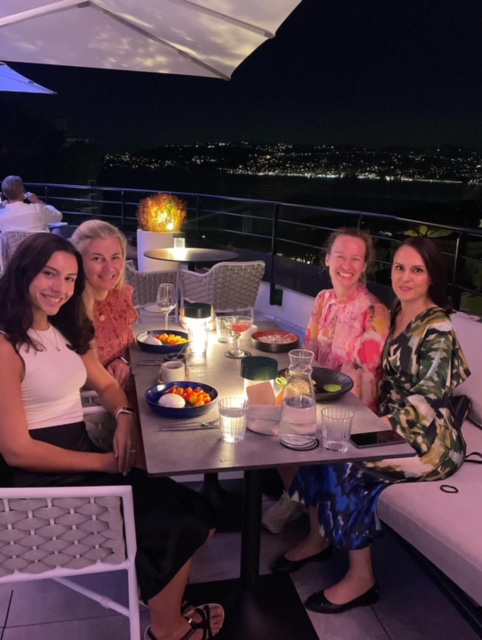
I ended the evening by running into two other crewmembers completely unexpectedly in Gamla Stan, the old town. Out of all the restaurants in Stockholm, we had made the exact same dinner reservations at the same restaurant and were seated at side-by-side tables. Of course, we commingled tables and ended up laughing hysterically over dinner, before capping our evening at a rooftop bar near the hotel.
Was it a whirlwind 24 hours? Yep! Would I do it again? Duh! Already planning my next out-of-base pick-up.
This job has its moments where you want to scream, so you have to take advantage of the perks. For me, that’s continuing to see the world as I always intended when I started CulinaryHopscotch. Only this time, it’s a paid ride, a paid roof over my head, and some walking around money to do cool things like this. Onto the next one!
Wow. To say I’ve had a little “jet lag” with Culinary Hopscotch is an understatement. Covid obviously contributed to the lull in posting, but I realize that I’ve let a lot of culinary moments go unshared even in the wake of the pandemic.
One major event is that I moved on from JetBlue to Delta, but most people probably know that by now. It’s been such a great decision, and one that has already given me the opportunity to not only see places I never dreamed of, but also to revisit some of the places I first visited as part of Culinary Hopscotch back in 2010.
I’ve had layovers in Milan, Paris, Venice, Nice, Barcelona, London, Amsterdam, Sydney, and Tokyo. And each time, I’ve made it a point to track down something that would rock the culinary Richter scale. I just never sat down and wrote about it! I need to comb back through my notes and document what I did, because I’m constantly getting asked for recommendations from people for their travels.
Up next: Stockholm, Sweden
I have a food-centric walking tour booked, reservations at two places for dinner, and probably way more planned than I could ever hope to accomplish in 24 hours. But that’s the awesome part about this job. Find a place, fall in love with it, and use those benefits to go back!
Anyway, it’s time to give this blog a renaissance. Make it a point to document these experiences after they happen, and share them with the people who love reading about it. So that settles it. Welcome back to Culinary Hopscotch!
One week from today, I’ll be sitting in sunny Orlando at our first day of JetBlue training. I’m in the process of getting organized and not the least bit worried about packing, which is why I have time for this blog. Yes, this is abnormal for most females, but I packed in a carry-on for three months when I went to Europe for Culinary Hopscotch. I figure this should be a drop in the bucket.*
The thing that has me the most perturbed isn’t what I’ll wear on the first day of school or if I’m going to forget all of the airport codes when I get there. It’s how I’m going to eat for three weeks. You didn’t think I’d let this get too far from Culinary Hopscotch’s original roots, did you?
Here’s the deal. Breakfast is included at the hotel, but we’re on our own for lunch and dinner. Seems fine, but I refuse to subject myself to Tony Romas and other airport-adjacent chain restaurants for 21 days. My waistline and palette can’t handle it. And when you factor in that our rooms only have a microwave and a fridge, I get a familiar, September 1998 feeling, like when I flung open the door to my UCSB dorm for the first time.
Drastic times call for drastic measures, so I’ve conjured up a manual, we’ll call it, to help me think of things I can easily prepare with these rudimentary appliances. Hop into the suitcase, PETA’s Vegan College Cookbook…you’re coming to Orlando with me! Turns out that finding a microwave-friendly cookbook is, ironically, kind of a PITA.
While I won’t “Let PETA turn (my) room into the campus destination for amazing vegan food” (it seriously says that), I’m hoping that the “on a budget” and the “most complicated kitchenware you’ll ever need is a microwave” advertisements pan out. Screw the parts about stocking my mini fridge with things that never had a pulse and not putting metal in the microwave; I’m appliance-challenged, not an idiot. Or maybe I am. I spent $10.50 of my hard-earned American money on a book with a recipe called “Brainy Bac’n Cheese Toast.” Top one slice of bread with tomatoes, fakin’ bits, and cheese. Microwave and top with the remaining slice of bread.
Here’s hoping I don’t toss PETA in the trash on my way to a heaping plate of Tony Romas’ ribs. Or worse, use the book as a placemat.
*I’m also checking bags for the first time in about five years thanks to a business-casual dress code
Due to technical difficulties, I cannot get the photos off my camera. I will update the post with my actual pictures as soon as I can. In the meantime, this is the grinder at the tortilleria where we sampled the amazing Nixtomal corn tortillas!
After spending a week in Cabo at perhaps the most ridiculous house I’ve ever stepped foot in, I had an epiphany: working after a week of vacation reminds me that I’d rather be on vacation. I think I’ve been holding onto this post in my head as a way of prolonging the week we spent doing nothing. Well, almost nothing. Between Coronitas and dips in the pool, I managed to sneak in a cooking class. And boy…I’m glad I did.
If you ask an American what Mexican food is, you’ll get a different answer depending on the geographic location of the person you’re interviewing. In middle America, Tex-Mex is all the rage, but a Californian would hang you for trying to pass off anything as Mexican that wasn’t fresh tacos or a bulging burrito. And then there’s actual Mexican food that doesn’t resemble either of these things.
My Cabo cooking class was titled “Mexican Comfort Foods.” Not having a ton of experience in the genre, short of what I filled up on at Gay and Larry’s growing up (RIP), I wasn’t really sure what I was in for. I met Donna in the parking lot of a large grocery store near downtown, and truth be told, I wasn’t sure who I was looking for, how many people were going to be in our class, or what we’d be doing that day. One of my favorite parts about taking all of these different classes around the world is that no two have proved to be the same yet. And this was no different.
Once we assembled our group, Donna had me jump into her car and she whisked us over to an authentic tortilleria for lunch. Lunch? I thought I was going to a cooking class. Smart not to argue, we pulled up to the al fresco restaurant and sampled some of the freshest tortillas this side of Oaxaca. The “Tortilla Goddesses,” as Donna so dubiously named them, barely speak English and turn out hot corn tortillas straight from the comal. They start by making their own Nixtomal, a mixture of corn, limestone and filtered water that’s passed through a grinder. That’s their masa, and this technique has been going on for thousands of years thanks to the Aztecs. There I was, literally eating history. My God, history tastes good.
From there, we headed back to Casa de Colores, or “House of Colors” in Spanish, where Donna lives. Her charming abode is perched on a lookout in Cabo and you can see all the way to the ocean. It’s also aptly named–the terracotta exterior is trimmed with colors borrowed from the rainbow, and in Mexico, this aesthetic just works. She conducts the cooking classes from the upstairs part of her house in a well-equipped kitchen that is perfect for groups of about six people. That day, there were five of us and Donna.
When we arrived, she served us a delicious Agua de Mandarinas “fresh water” to wet our whistle and get us ready for a serious dose of Mexican comfort classics. We started with a discussion of the comal, a word she uttered at the tortilleria that left all of us scratching our heads. Whether industrial sized or plate-sized, a comal is a staple in a Mexican kitchen. Put simply, it’s a disk of steel that you cook on with dry heat. We immediately put the comal to work with roma tomatoes, a white onion, serrano chilies, and garlic. We were making a cooked salsa!
After we blistered the ingredients on the comal, we transferred them to a blender and pulsed it all together. The juice from the tomatoes served as the liquid, and what we tasted was smokey and fresh. To deepen the flavor further and thicken it up, we “fried the salsa” for 10-15 minutes in a Tbsp of oil on the stove top. It really did the trick, enriching the flavor and deepening the impact.
That was our fresh salsa, but we also had a discussion and worked with dried chilies. I think one of the most common misconceptions is that Mexican ingredients like the ones we used are hard to find. Guilty of the same assumption, I was wondering where I was going to find dried guajillo chilies in Portland. So you can imagine my surprise when I flipped open the Penzey’s Spice catalog that came in the mail to find they sell them there…right up the street. I also happened to spot Nopales (cactus paddles) in our regular old Safeway yesterday too. So, there you have it…even in rainy Portland, we’re cookin’ Mexican!
Back to the guajillos. These deep red peppers are fairly mild but have a great flavor, and are very popular in Mexican sauces. Donna pulled out a few dried ones, we smelled them and felt their texture, and then we chopped them up. We reconstituted them with boiling water from the stove, and let them sit for a bit to come back to life. This “Devil Salsa” that we were putting together was a cinch. We pureed the chilies in a blender with their water, and then passed them through a sieve to strain out the tough parts of the skin that no self-respecting human would want to chew on. From there, we simmered the sauce for a bit and that was that. We would turn our salsa into a masa dumpling soup, use it later on our chile rellenos, and Donna also mentioned that we could use it to make “Camarones Diavola,” or devil shrimp served over rice. Another option: add chicken stock and turn it into a tortilla soup. “Devil Salsa:” the gift that keeps on giving!
Another enlightening part of this class was the chile relleno. I remember my Grandma Elsie always ordering this dish, but I never really knew what it was. With my childish, undeveloped palette, I never asked to try it, but suspected that it was a deep-fried chili pepper stuffed with cheese. I was sort of right. The only difference in the traditional Mexican version is that it’s coated with a fluffy egg mixture that creates an omelette around the chili when it’s fried in the hot oil. A lot of restaurants will take short cuts and bread and deep-fry a chili to pass off as a relleno. It’s a cheap knockoff though, kind of like plastic shoes that cut your feet.
If you’re headed to Cabo, take a break from the chi-chi’s and guys selling your name on a grain of rice. Make some time to venture out of the mayhem and sample some authentic Mexican cuisine. At Casa de Colores, you’ll learn about a tortilla environment, discuss moles, and talk a lot about Mexico’s culinary culture that stretches from border to border. And you’ll also start to realize that although Mexico borders Texas, it scoffs at anything Velveeta or Rotel related.











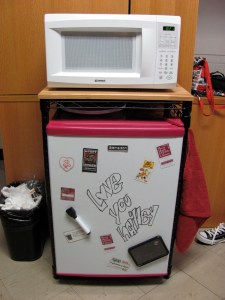 One week from today, I’ll be sitting in sunny Orlando at our first day of JetBlue training. I’m in the process of getting organized and not the least bit worried about packing, which is why I have time for this blog. Yes, this is abnormal for most females, but I packed in a carry-on for three months when I went to Europe for Culinary Hopscotch. I figure this should be a drop in the bucket.*
 Culinary Hopscotch