There’s nothing quite like Paris in the rain. The forecast called for showers upon our arrival, and the thunder and lightning show we received after arriving at the hotel certainly delivered. But as the weather goes in Europe, if you wait five minutes, it will probably change. And it did just in time for aperativo hour on the 34th floor of our hotel.
I was a bit nervous about the dinner I had booked if it was going to be raining. You see, Bustronome brings new meaning to the term “meals on wheels.” The idea here is that you see the sights while eating your meal as the bus winds around the different arrondissements. I feared that the visibility might be compromised for us diners, not the driver. But Mother Nature cooperated and we were treated to a unique and excellent culinary experience under the domed glass roof of a double-decker bus.
Dinner Starts at L’Arc de Triomphe
Bustronome Upper Deck
Our evening started adjacent to L’Arc de Triomphe. As the six courses (and wine pairings, if you opt-in) were delivered, I had a lovely conversation with the owner’s daughter. Once she discovered that I spoke French, she insisted that we only converse that way for me to practice. Bien sur! The six courses included a raw salmon starter with yuzu, chestnut cream soup with roasted morels, a roasted cod with barley risotto and crisp carrots, a filet of beef with parsnip purée and beef jus, a cheese course of Ossau-Iraty, and a decadent Opera Gateau chocolate mousse cake for dessert.
This gourmet travel experience cost €120, and the wine pairings were extra. The food was excellent considering it was being served from the lower level of a double-decker bus navigating Paris’ sometimes unforgiving cobblestone streets. And the menu rotates just like the wheels on the bus, so there are often repeat guests. That should tell you that it’s a lovely way to dine in a city that has the most One Michelin-starred restaurants in the world. 639 to be exact.
Customized Acrylic Glass Holder
Musée du Louvre
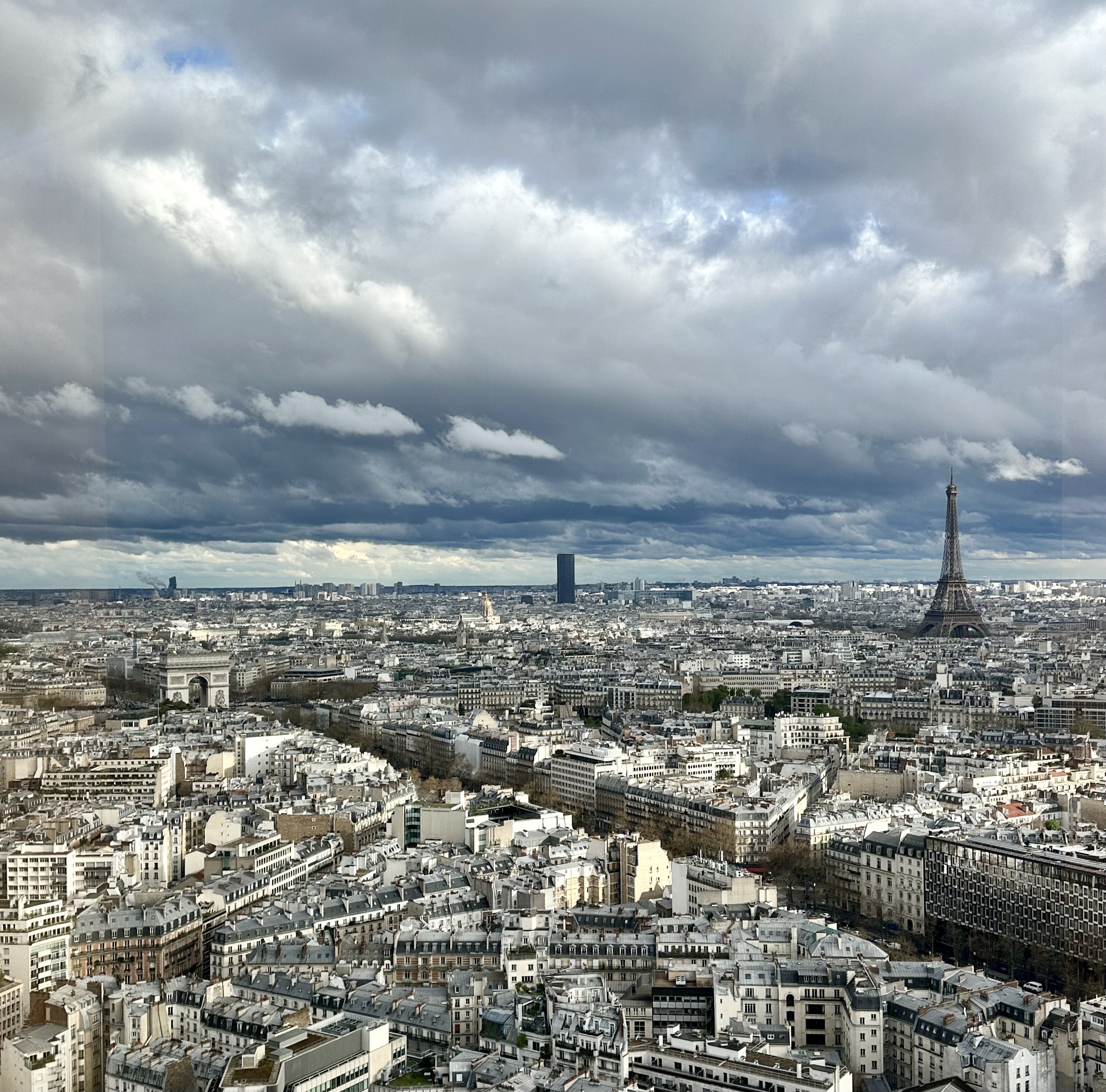
We snaked from the right bank to the left bank as the sun set over Paris taking in sights and monuments like Place de la Concorde, Musée du Louvre, Hotel de Ville, the Pantheon, Place Vendome, and more. It ended up being a completely clear evening, which gave awesome views from the bus’s large picture windows and glass domed roof. This made the final stop at the Eiffel Tower picture-perfect, as it was timed at 10:00 p.m. for the light show.
When you only have 24 hours in Paris, you have to make the most of it. Mine came on a work layover, or a paid vacation as I affectionately refer to it as. So, Bustronome was a genius way to kill two birds with one stone. If you’re headed to Paris with a limited amount of time, I definitely suggest this as an option. It’s easy to book on OpenTable.com, and they were extremely responsive over email with a quick question that I had.
The Eiffel Tower at 10:00 p.m.
Bustronome operates three buses in Paris, along with a London bus as well.
As many of you know, I just returned from some time away in the South of France. It should come as no surprise that I love spending my travels learning new things, and this was hardly an exception.
Several months ago, I got the idea of going to France for an immersion-style getaway where I would stay with a family during my time there. The hope was to improve my French speaking skills, and what better way to accomplish that than by living with at least one native speaker? I had been looking around, but wasn’t really finding anything that felt like the right fit.
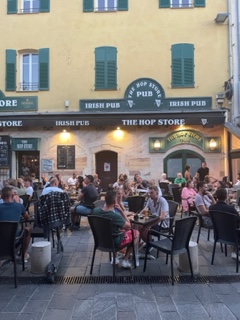
Port Campus: Above the Irish Pub
In doing additional research and talking to coworkers, I stumbled across something even better. A French school called Centre International d’Antibes. They’ve been around since 1985, so they’ve been doing this for quite a while, and it seemed like it was worth looking into. Especially because they are accredited by my airline in the event that I decide to take our language of destination (LOD) test to be a French speaker.
I looked over what they offered, submitted my intent to enroll, took my placement test, and a few months later, I was on the nonstop flight from Atlanta to Nice.
Le Figuier de Saint Espirit
Several people asked me to recount the experience after I returned, and I figured the best way to capture this information was on my blog. I mean, let’s face it: I stuffed my face along the way too at some pretty incredible restaurants. I’ll include the names and links to those at the bottom of the post! For consistency, of course.
But first: a recap of my week as a student in the South of France!
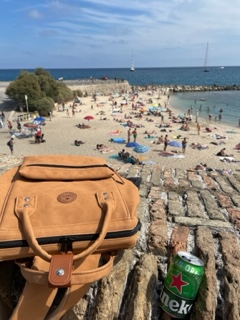
Plage de la Gravette
The first thing that comes to mind is just how happy I am that people arrived from all of the world to study a foreign language that wasn’t English. We’ve come to a time where English has become the default language around the world. You say something in a foreign language to be polite or try your hand, and the person invariably replies in English, because they also want to practice. But sitting in my French classes (where, of course, everyone in the room spoke English in some capacity), it wasn’t allowed. We were there to speak French. Et c’est tout.
Pan Bagnat Cooking Class
My class was filled with all walks of life from around the world. It was fun to be one of the only Americans, and they were shocked that I came from so far away for just a week’s worth of classes. But such is the life of a flight attendant, which I explained to them on day one when we introduced ourselves. We had someone as young as 15 years old in our class; a young girl from Switzerland spending three months studying. All the way up to a 65-year-old hoping to better his French skills. It was an all ages affair.
Field Trip to Grasse
And because I enrolled in the Cultural Program, where we went on field trips each afternoon post-class, I met even more people. As a quick recount, there were students in the program from Denmark, the UK, Bratislava, Brazil, Norway, Botswana, Canada, the Netherlands, Australia, and several from both Switzerland and Germany. Plus, I’m sure many more.
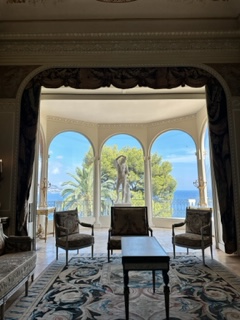
Villa Ephrussi de Rothschild: Saint-Jean-Cap-Ferrat
There are actually two school campuses, and most of us spent our week down in the Port of Antibes location. It was really cool because we were right in the middle of it all, and could go grab a croissant and something to drink on our quick, mid-morning school break. I even had a laid-back lunch or two before rejoining the group for our afternoon excursions. I will say that it was quite a hike from the “Dormtel,” a word that I made up to capture the spirit of where we lived. Was it a dorm? Was it a hotel? Who could know. But this is where we were assigned to live for the week near Juan-Les-Pins, and we braved the heat and humidity each morning on our journey to school. I suppose that’s how French women don’t get fat; they walk. Everywhere. Rain or shine. C’est la vie.
Le 1939 Hotel: Quinto Cielo
Some other observations I had were just how many returning students there were! One guy in my class (a train conductor…how cool is that?) comes every year, and he knew our professor, Patricia, and also knew that it was her birthday the final day of class. So he brought Swiss chocolates as a gift that we all shared in the classroom.
Another new friend, a Lufthansa flight attendant named Suz, said she plans to come back monthly and pop-in for a week here and there. You can only imagine how my geographical jealousy took over when she told me that! There were actually a number of flight attendants (past & present) who I met during the week. Maren was the first person I spoke to while we waited for our rooms to be ready in the “Dormtel” courtyard. We got to talking, and she had been a flight attendant for 27 years with various European airlines. Suz, Maren and I swapped stories all week at dinner, while the others laughed and listened to our wild tales. And Maren got to live vicariously through us since she now has an office job.
Wine Tasting at Château de Crémat
The real takeaway here is just how big the community of international travelers is who take foreign language holidays. It was really incredible! I almost cried on the last day of school because I was genuinely sad to leave. It was by far one of the most rewarding and fun experiences I’ve ever had. I made fast friends with a small but unique group of people who I have no doubt I will see again. I’ve already started brainstorming work trips to see some of them. I’ve said it before and I’ll say it again: there’s nothing like this job if you’re an international citizen with friends in all corners of the globe.
But back to the classes. My class was level A-2, and it was taught rapidly and entirely in French. There were only 12 of us in the tiny (and sweltering) classroom with varying degrees of French speaking ability, so that made the classes both fun and challenging. Occasionally, we would whisper something to each other in English for clarification. And Google Translate helped us search for words we didn’t know or needed to see for ourselves. It was so weird to be a student in the 21st Century with technology at my fingertips!
Would I go back and do this again like some of the friends that I met? Absolutely. In fact, I plan to. Maybe even with some of those friends. But I will definitely go for longer than one week next time and I will stick with an Airbnb in town. The one I rented for my first two nights in Antibes was less than a three-minute walk from school and it was perfect. I would choose that next time without a doubt.
Port Vauban: Antibes
I also want to speak on Antibes, where the classes were held. I didn’t do a ton of research ahead of time, which is unlike me, and I didn’t really arrive there with any expectations. But I kind of liked it. It allowed me to take it all in and form my own opinion with boots on the ground. And that opinion is, Antibes is magic.
It’s not flashy at all. It honestly reminds me a lot of Newport Beach before so many nouveau-riche people moved in and have changed it for the worse. It’s really just a beach town with a giant port (2,000 slips, to be exact) attached. That makes it the biggest anchorage in Europe, so you can bet that there were some pretty incredible yachts bobbing in the harbor. But you would never know it on-land. On the last day of class, our assignment was to take a list of questions and interview people around town. Three of us set out, half expecting to be shut down at every turn. But it wasn’t like that at all. People were friendly, interested and truly excited that we had come from three different countries to learn their language and enjoy their port city.
Domaines Ott: Bandol
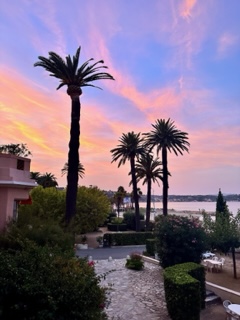
Sunrise in Bandol
After Antibes, I took the train to an even smaller town to the west called Bandol. The French rosé we love most in the world hails from there, so it seemed like a logical choice since I was already so close. I stayed for two nights with assistance from an amazing Airbnb host. She helped me correct an idiotic oversight that almost left me homeless there for a night. I guess there are worse places to be without shelter than a beach town on the Cote d’Azur though! In fact, the little town is so small that I think it only has one Uber. She was appalled when we looked up the price to go five minutes back to the train station on Monday morning, and she couldn’t take me because she had to work. So, she phoned her Mom & Dad and they came and picked me up. When I tell you that I continually run into the most hospitable people around the world, I mean it. They spoke very little English, and were thrilled to hear about my courses in Antibes as they whisked me to the platform for my train to Marseille and then onto Paris.
The takeaway here is that you’re never too old to be a student if you really want to be one. And as a lifelong learner who has intense intellectual curiosity, I’m always going to further my pursuit of education, whether that’s with a whisk in my hand or a pocket translator hidden from my professor’s view. Because let’s face it, there were probably just as many lessons learned outside of the classroom along the way as there were inside of it.
Today is my last day in Paris. How do these trips always manage to fly by so quickly? We were fortunate to have gorgeous weather for our entire trip, minus today. It’s rainy and cold. C’est la vie.
With no plans, we just started wandering around this morning before the impending deluge. Many shops and restaurants remain closed for the August holiday break, but thankfully, a few of my favorite cooking shops and patisseries were not.
I made my way to Rue Montorgueil, right by the apartment we rented last time. There, I purchased boxes of tiny macarons at Stohrer, one of the oldest bakeries in Paris. One box is a gift for the flight crew tomorrow, and the other will be coming back to Texas with me.
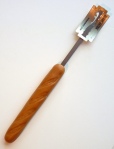
The main reason for heading over to that part of the city was because I wanted to purchase a lame (pronounced “lahm”), which is the tool that’s used to score the top of baguettes. This is just in case I decide to try my hand at baking them in Houston. I knew just the place to find it. E. Dehillerin! And, I was pleased to find it open. Bonus! It took me awhile to find the lame, which was literally under my nose in the first place I thought to look. But, in wandering around trying to find this little gadget, I also found two whisks in varying sizes that I couldn’t live without. So, I purchased my new cookware and headed out to G. Detou nearby.
There, I was looking for powdered food coloring that’s used to make macarons like the fantastic one pictured above. This ingredient is not cheap, and since I’m not in the business of making many batches right now, I settled on one. A chose a marigold yellow color that I’m hoping I can play with to achieve a variety of sunshiney colors.
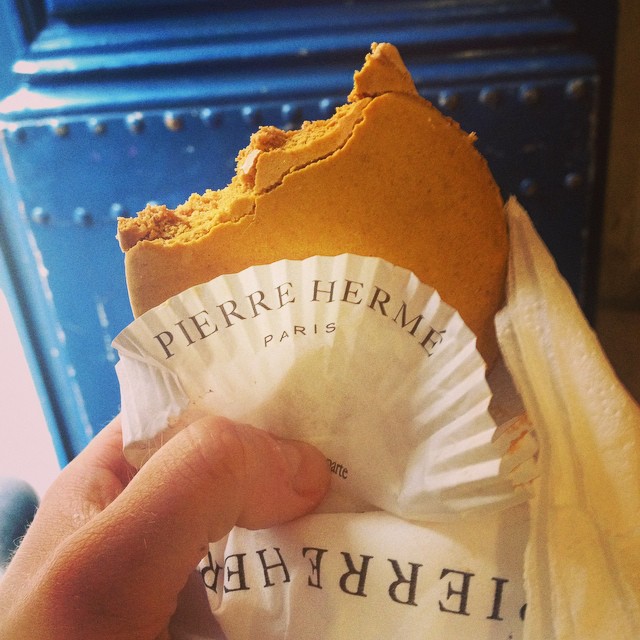
I snaked my way back to the Marais in the rain, and happened upon Pierre Hermé, the rival patisserie to Laudrée (if there is such a thing here in Paris). I just wanted a small taste of their salted caramel macaron, but being the excellent vendeuse that she was, the shop attendant talked me into the monster-sized one. And it was worth every damn calorie.
For me, the best part about today was having no agenda and navigating around purely by memory. I love walking past a shop or restaurant and having a memory come flooding back. It happened today when we passed Costa Coffee (I’ll never forget ducking inside one in Budapest to escape the cold that was so harsh, I couldn’t even type on my phone), and again when I passed a boulangerie near the Centre Georges Pompidou. I thought, ‘I remember buying a baguette somewhere around here and walking around eating it.’ I looked left, and sure enough, there was the bakery in the same spot.
I can’t even remember which trip that was on, and that’s happening with more frequency as I visit Paris more often. Memories get jumbled up, but the internal Thomas Guide is becoming sharper with every visit. So, as is typical of the day before leaving an amazing city, I’m already plotting my return!
I never imagined it would be this cool in Paris in the summer. There’s a crispness in the air that seems better-suited for autumn, but it sure is a welcomed reprieve from the heat and humidity in Texas. After dumping my belongings at the apartment in the Marais, I went for a walk to Ile St. Louis. There are a number of great cafés, and I figured it would be a good place to line my stomach before my baking class nearby. Soup à l’oignon gratinée and a glass of rosé. It’s becoming my welcome répas each time I visit.
My class started promptly at 2:30pm, and three-quarters of us managed to arrive nice and early. That led to a prompt start, with two ladies straggling in while we were elbow-deep in flour and poolish. We were as lost then as you likely are now regarding the word, but we mimicked what Chef Eric was doing nevertheless. More on poolish in a bit.
I paired up with a really nice girl named Kate, who ironically used to live in Houston. Her husband’s job (he’s a geologist to the oil industry) moved them from the land of humidity and queso to Paris, so here’s hoping Brady and I might follow in their footsteps. Between bouts of kneading our dough correctly and sometimes not, we swapped stories about Houston, restaurants we both like there, etc… It was kind of like taking the class with a friend.
But back to the boulangerie. The first thing that struck me regarding baguettes is the simplicity of the ingredients. There was a quiz on our recipe sheet that indicated there were just four, which immediately made me think of “Reinheitsgebot,” the German beer purity law. These Europeans take their food and beverage very seriously, so much so that they have enacted laws like these that protect the traditionality of certain products. The French law called the “baguette de traditional française” was signed into law on September 13, 1993. There are also specifics regarding the length, width, height and weight for anything being sold as a “baguette.”
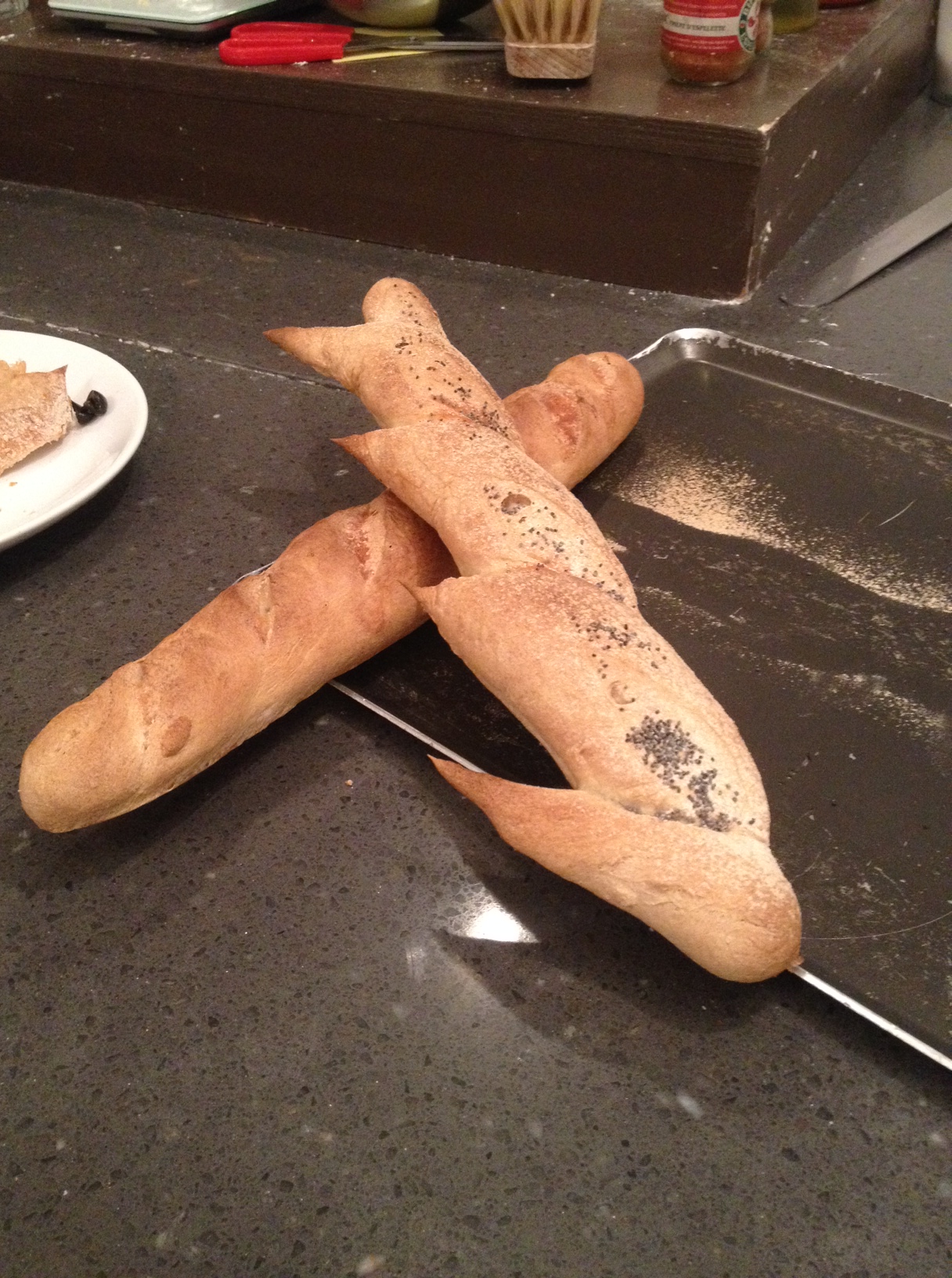
So, what goes into a these bread swords you see sticking out of fashionable purses around Paris? Nothing more than bread flour, salt, water and yeast. Oh, and elbow grease, but that’s an unspoken addition. It really wasn’t all that difficult to create the baguettes, but you do need counter space and a willingness to demolish a tidy kitchen. Baking is messy. There are no two ways about it.
Something else that you will need is a kitchen scale. Like Chef Diane from my macaron class in November (who I saw briefly today), Chef Eric also drove home the point that weighing your ingredients is the way to go. Note to self: purchase a kitchen scale. You’ll need it to create the poolish, a starter that’s made three to 18 hours ahead of time to jumpstart the fermentation process. It’s nothing more than bread flour, water and fresh yeast, but this step makes a marked improvement in the bread’s flavor.
Perhaps most important of all, though, is the double proofing process where you allow the dough to rise after kneading it, and then again after it’s formed into a baguette shape. The baguettes will double in size during this process, so if it’s twice as big as when you started, you’re on the right track. It’s also important to score the baguettes with a razor or small tool, which allows steam to escape. Most bakers have a unique score for their baguettes that is likened to an artist’s signature on a painting.
I’m not a baker. I repeat: I’m not a baker. I don’t like to measure, I don’t have an egregious sweet tooth, and I certainly don’t have the patience or gadgetry that’s required of most baking projects. But that doesn’t mean I can’t appreciate the craft, especially something like freshly baked French bread. It’s one of the best parts about roving the streets of Paris.
A major takeaway from this class was that we cooked in normal, convection ovens. The kind you would find in any home. A critical aspect of the baking process is steam, which can be achieved by tossing a few ice cubes into the bottom of the oven or by using a spray bottle intermittently. Outstanding tips that I likely would not have otherwise thought about!
That’s all for now. Another great culinary experience in the books! If you’re ever in Paris (or any of the places I’ve traveled with Culinary Hopscotch) and want recommendations of cooking classes or other culinary adventures, please let me know.
In preparation for my trip to Paris, I packed “My Life in France” by Julia Child and brought it back east in my crew bag. I figured I would re-read it on the jumpseat to drum-up excitement for my trip. I read the book prior to conceptualizing Culinary Hopscotch back in 2009, which was some time ago. I don’t know why I’ve never thought to read it again.
In just one short chapter (the introduction, actually), I’m amazed at the many similarities and connections I now see between the two of us. By no means is this comparison meant to be culinary in nature.
First off, for those who follow my #crewlife tales, you’ll remember that I just visited the Smithsonian exhibit of Julia’s kitchen in Washington D.C. a few days ago. The layover was planned, but riding bikes to the National Mall with my crew was not. As luck would have it, we all split up and went our own ways, finally giving me the opportunity to go see this exhibit. It also happened to be Julia’s birthday that day, which I didn’t know until after the fact.
The kitchen is an exact replica of the one from Paul and Julia Child’s Boston home, the city where I spend half of my time flying for JetBlue. Secondarily, Julia is from Pasadena, California, just up the road from where I grew up in Newport Beach. Two California girls, navigating Boston’s unique mixture of culture and unpredictable weather.
But perhaps most interestingly, she penned “My Life in France” in Montecito in 2004, just down the road from where I attended college at UC Santa Barbara. I graduated two years prior. I’m shocked that I never ran into her while babysitting for a family in her neighborhood, or at La Superica, her favorite hole-in-the-wall Mexican restaurant that is adored by college students and famous foodies alike.
More than anything, however, our love of France– Paris, specifically– is what strikes a chord with me. There are so many ways to see Paris, but in mine and Julia’s opinion, the City of Light is best viewed through a culinary lens with a fork always at the ready.
While writing this, I was shuttling people back and forth between the Northeast and West Palm Beach, an oft challenging crowd for those in the know. I wasn’t about to let them get to me. Tonight, I’ll be boarding a flight to Paris. And on Thursday, joining a baking class where I’ll learn to make baguettes and other doughy delicacies in a home oven. You can keep the palm trees and the beach; I’m heading to where the magic is made in café kitchens, patisseries and in a small hole-in-the-wall Mexican restaurant along Canal St. Martin.
For those who read about my macaron class in Paris last November, this is the same small cooking school tucked along the Seine near the Marais. And it’s also the same place where my phone took a swim in the toilet last time. Evidently, geography and a love of food are not the only thing Julia and I have in common. Klutziness in the kitchen is as common as it is in life. One of my favorite quotes in the book says it all: “Maybe the cat has fallen into the stew, or the lettuce has frozen, or the cake has collapsed. Eh bien, tant pis!” [Translation: Well, too bad!]
Traveling back to Paris meant I’d have time for two more cooking classes…on the same day.
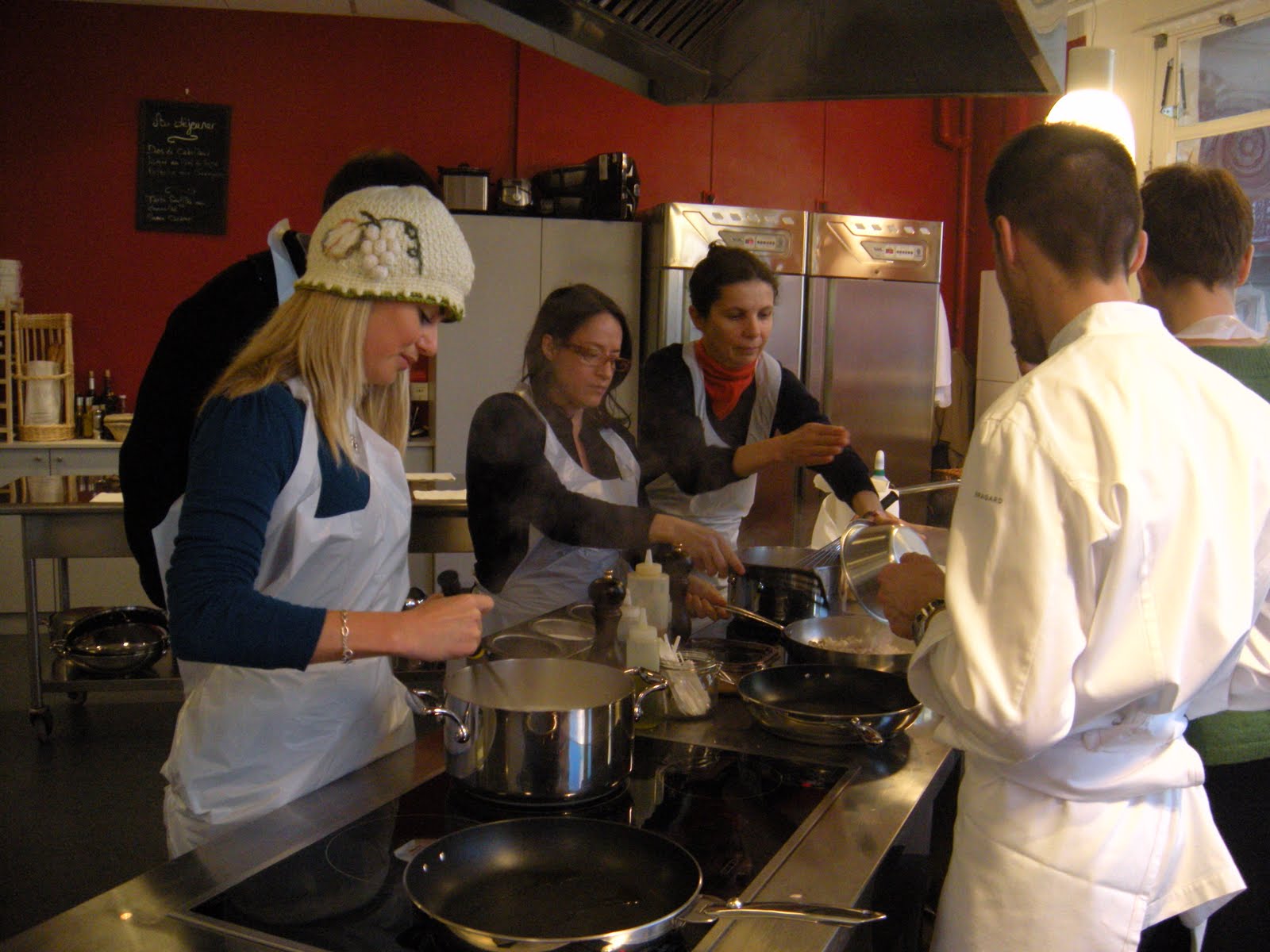
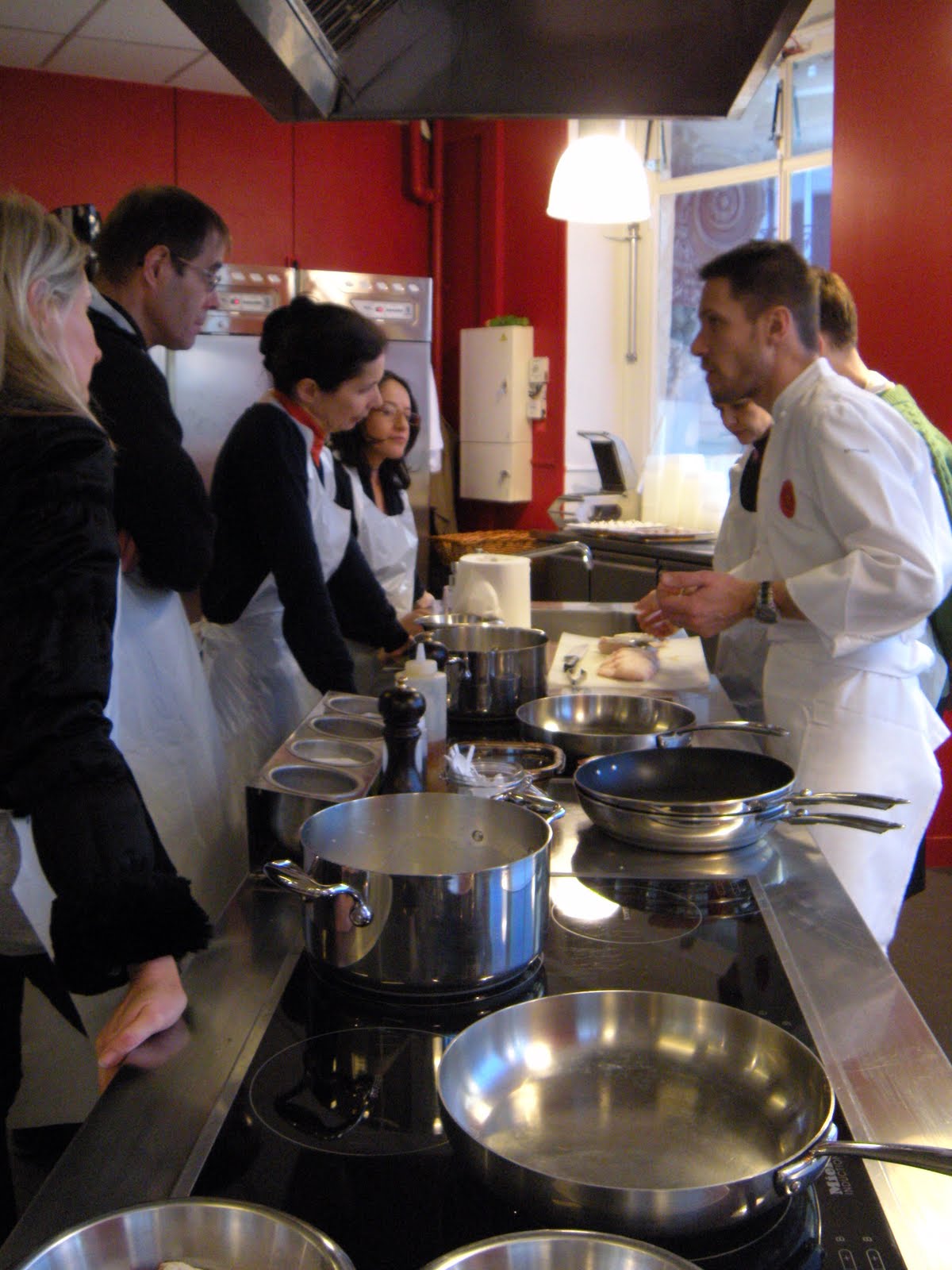
Ally and I participated in what I consider to be one of the best values in Paris today at Ateliers Des Chefs. There are six locations scattered about the city, and for €15, we cooked our way through a quick (30-minute) lunch menu in a rather chic demonstration kitchen at the BHV on Rivoli near Hotel de Ville. There were only seven us in the class, which meant it was pretty hands-on, and easy to take notes and follow along, especially since the classes are conducted in French.
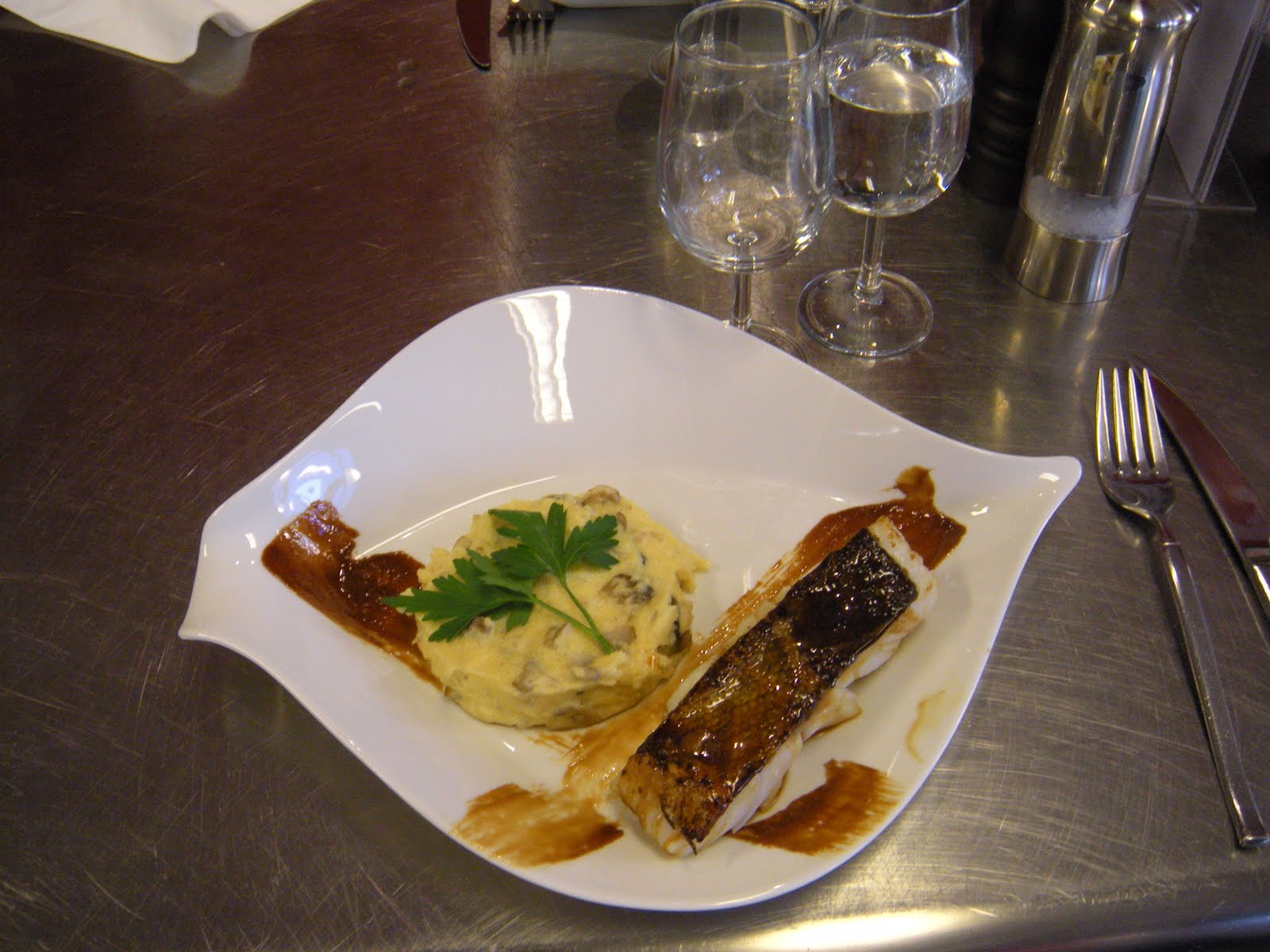
Menu:Codfish with a Honey-Soy Glaze and Polenta with Mushrooms
This menu was as easy as it sounds, and if you can understand French, these classes are a huge bargain. The menu was simple and truly done in 30 minutes (where were you on this one, Rachel Ray?), and the food wonderful when we sat down to lunch with the rest of our class.
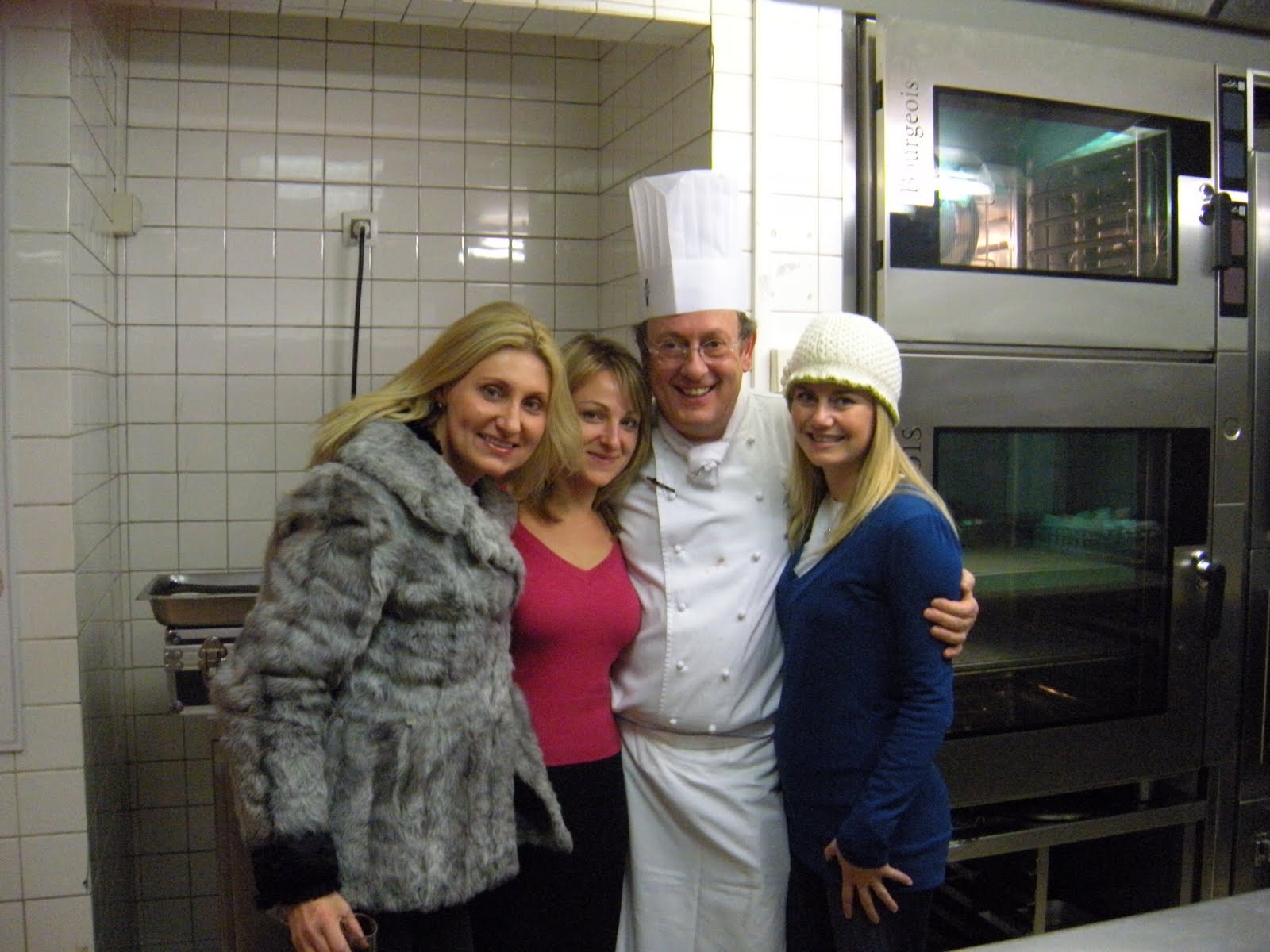
In the evening, Ally, Leila and I moved from one side of Paris to the 15th, home to the colorfully named culinary school, Le Cordon Bleu. It’s on a pretty residential side street, and if you weren’t looking for it, you’ll probably walk right past. In our second class of the day, however, we would get very familiar with butter, heavy cream, and milk on repeat in some version of that order. This was An evening In Honor of Julia Child.
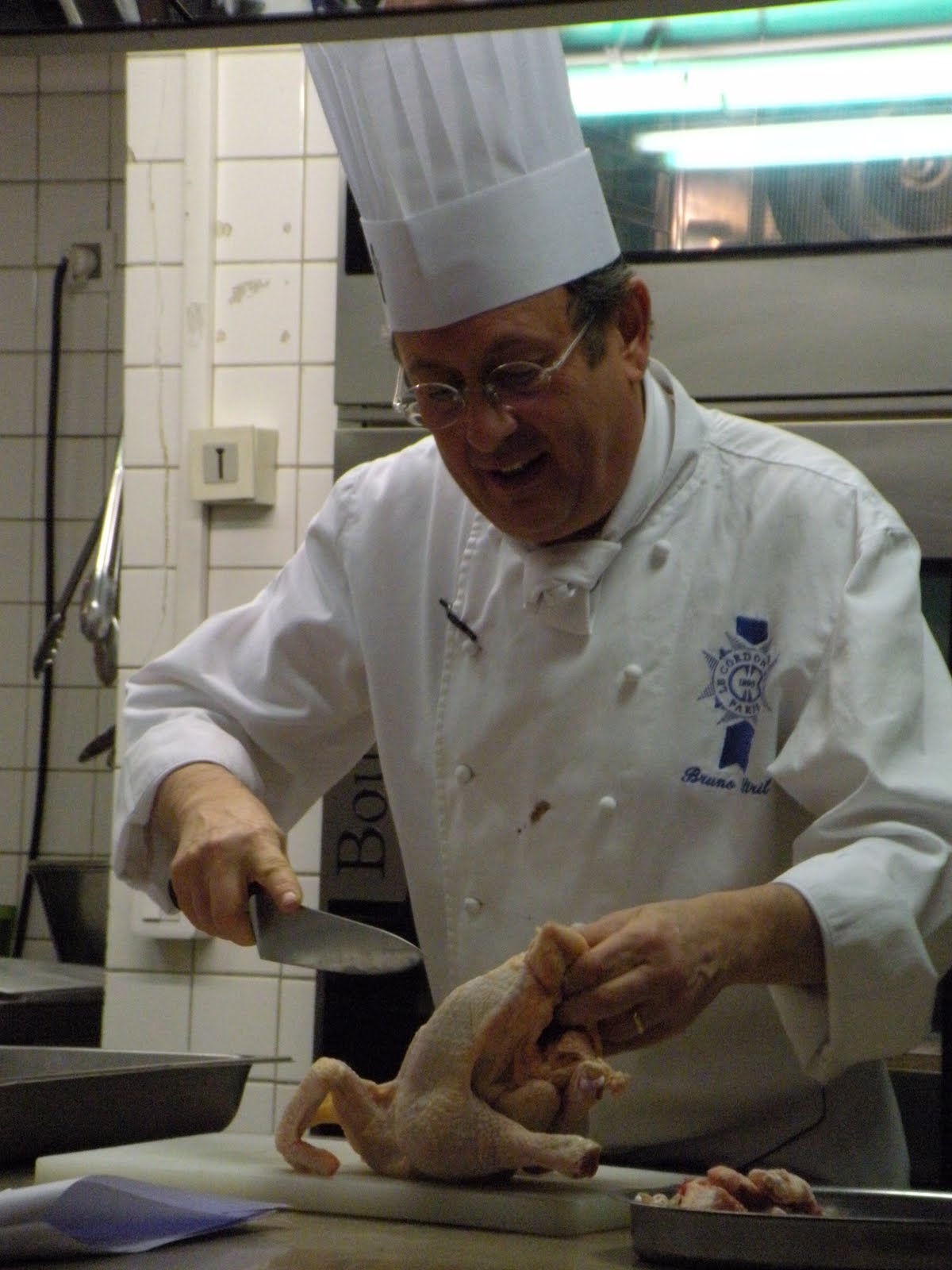
Entirely demonstration-based, the class at Le Cordon Bleu was three hours long. Chef Stril spoke only in French, but a translator was on-hand to assist the mainly English-speaking audience.
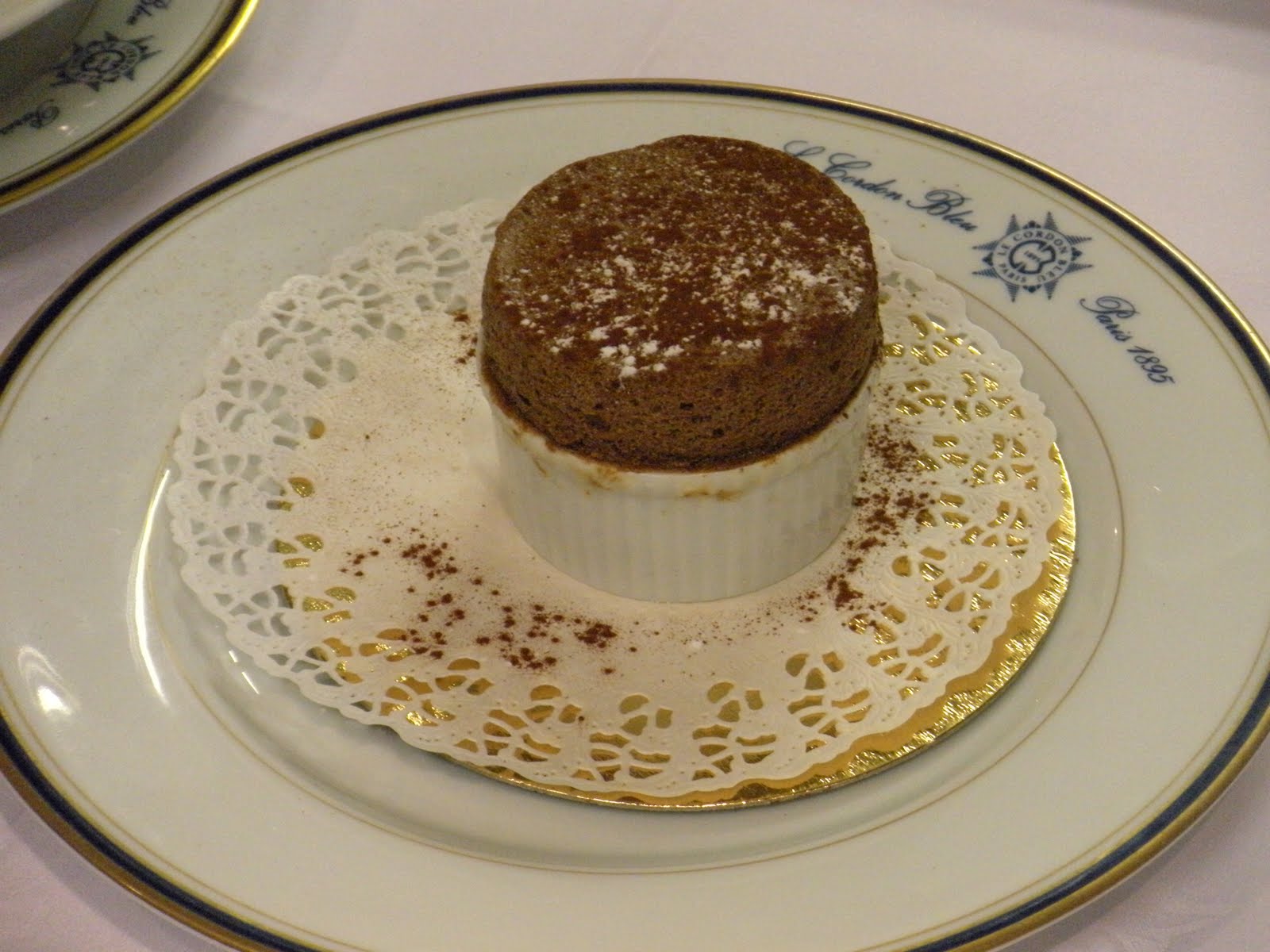
Menu:Coquilles St.-Jacques a La Parisienne, Fricassée de Poulet a L’Estragon, and Soufflé au Chocolate a L’Ancienne
We started out by making the pastry cream for the soufflé, and I have to say, I don’t consider the art of the soufflé nearly the death-defying feat I did in the past. Would I call this dish easy or fit for a beginner? Not a chance. But Chef did make it look easy. And all soufflés are bound to fall, so if that’s your hang-up, break out the ramekins and let it go. Chef Stril couldn’t be bothered as the air went out of his chocolate towers; he just opened another bottle of wine. C’est la vie, I suppose…
From there, we learned the proper way to segment a chicken into eight pieces for our chicken with tarragon sauce. Chef made quick work of removing the spine, and at dinner after (I should mention this class only resulted in Barbie-sized tasting plates..and wine…there was wine…), we all agreed that this was a skill definitely developed over time. And this dish took time.
He browned the chicken, then removed it, then used the chicken fat that had rendered off as the base for the sauce. We learned the right (and easy) method to peel a tomato, and then watched as two assistants diced them into uniform pieces for the Chef. He told us how there is always veal stock bubbling away in the Le Cordon Bleu kitchen downstairs because it’s involved in so many of their preparations; that went into the dish too. And we learned how to make a pot lid from parchment paper, which put our dish out of sight and mind while he worked on the scallops and potato cakes.
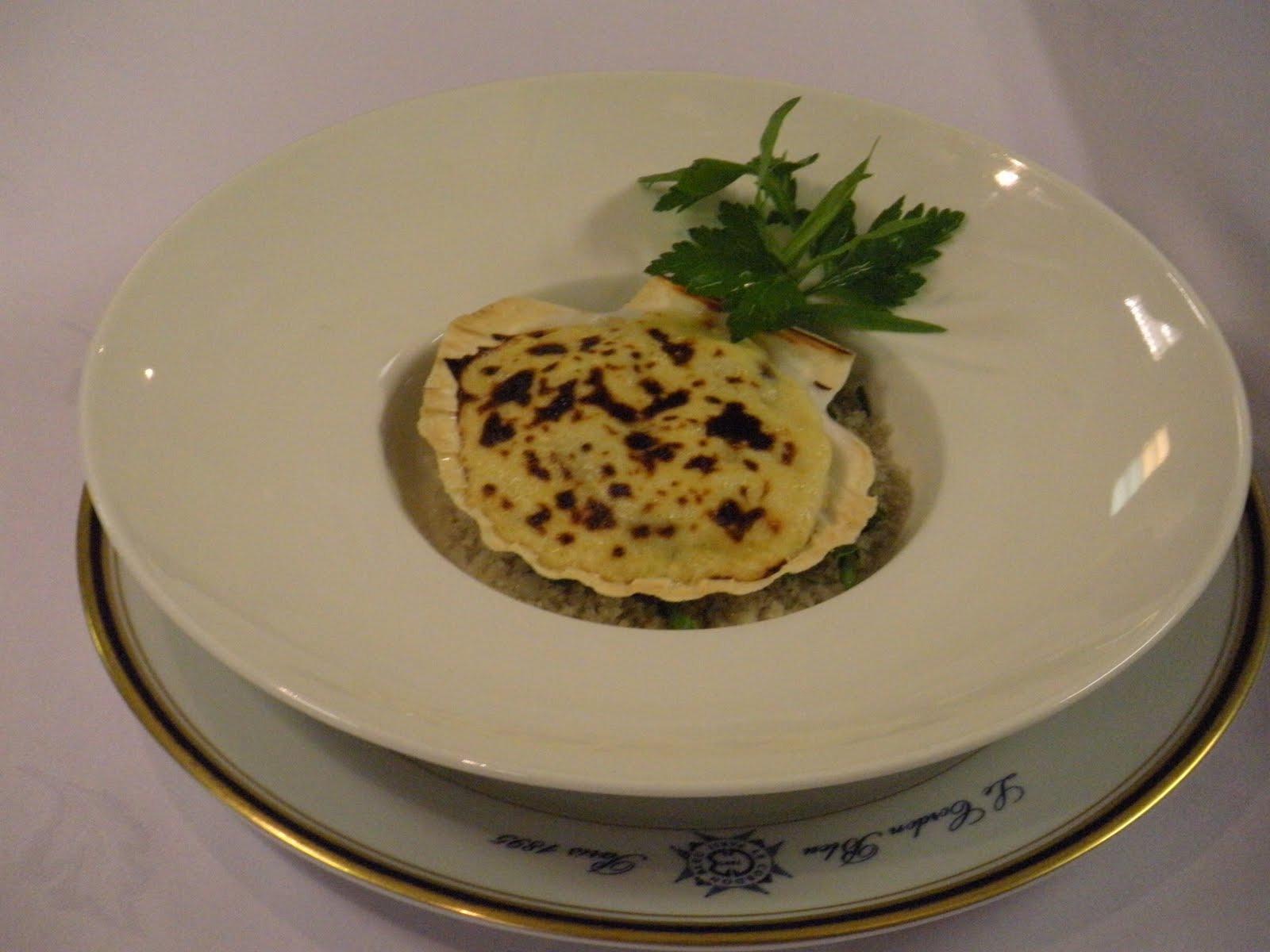
Our next dish was quite “Republican,” as someone I know likes to say: scallops and mushrooms in a white wine béchamel-style sauce served on the half-shell. This was the star of Chef Stril’s show; we all agreed on that. He opened up the scallop shells to access the meat, and kept the coral egg sack as part of this dish. It’s a gorgeous hue, but I didn’t have any on my plate and probably would have skipped it. After sautéing the scallops until they were only cooked part of the way through, he sliced them into 3mm disks and set them aside. He added shallots and sliced mushrooms to their pan, and then deglazed with white wine and added cream. At this point, he got started on the sauce. Butter, heavy cream, milk, and more, more, more of it all went into the sauce, and at the end, he tempered in egg yolks to help the dish brown under the salamander.
The result, a feast for the eyes and mouth. A buttered shell, a scoop of the creamy mushroom mixture, sliced scallops atop, and a slather of the béchamel to cover the shell. Under the salamander (a broiler would work too) for about five minutes, and Chef Stril had made somewhat quick work of the Coquilles St.-Jacques. I almost dove onto the table for the example one. It was that good.
I can see why they don’t let the audience participate in a menu like this one. It took our Chef about two-and-a-half hours to get this together and he’s been doing it for 40 years. It was a great learning experience though, and since it is hands-off, anyone could participate and have fun…young, old, or food-fearing.












 Culinary Hopscotch